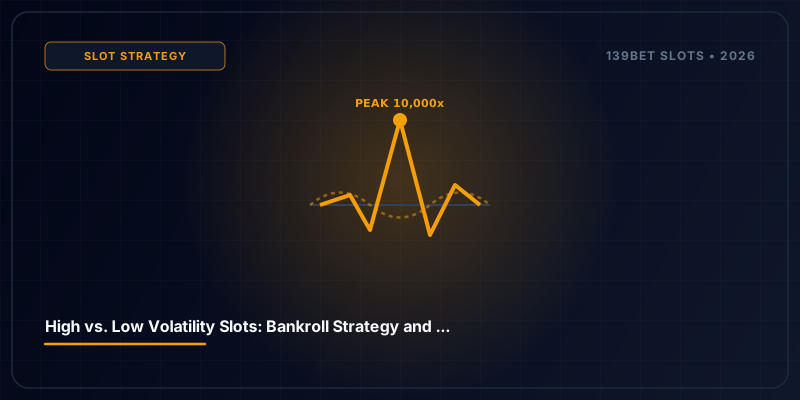
While Return to Player (RTP) governs the long-term mathematical payout ratio of an online slot, volatility (often referred to statistically as variance) dictates the risk profile and distribution curve of those payouts across short- and medium-term sessions. Two games possessing an identical 96.5% RTP can exhibit completely divergent operational behaviors: one awarding modest payouts frequently, and the other requiring extended spin sequences before releasing exponential jackpot rewards.
Defining the Three Volatility Archetypes
Slot mathematical architectures generally fall into three distinct variance classifications, determined by hit frequency algorithms and paytable structure:
1. Low Volatility Architecture
Low-variance games are programmed with high hit frequencies, typically awarding prizes on 25% to 35% of all initiated spins.
- Payout Structure: Multipliers rarely exceed 100x to 500x the base stake.
- Session Profile: Bankrolls experience smooth, gradual fluctuations with minimal drawdown velocity.
- Optimal Target: Ideal for fulfilling wagering requirements on deposit incentives or casual players prioritizing extended entertainment time over massive payout potential.
2. High Volatility Architecture
High-variance titles represent the dominant design trend across contemporary digital slots, exemplified by “Megaways” mechanics, cluster pays, and extreme bonus buy features.
- Payout Structure: Hit frequencies are low (frequently 12% to 18%), with substantial portions of theoretical RTP concentrated inside bonus rounds capable of delivering 5,000x to 50,000x multipliers.
- Session Profile: Prolonged sequences of non-winning spins punctuated by sudden, dramatic payout spikes.
- Optimal Target: Experienced participants equipped with sufficient bankroll reserves to withstand statistical downswings.
Low Volatility:  |--__--__--__--|  (Tight amplitude, stable balance)
High Volatility: _____/‾\_______|  (Deep valleys, sharp exponential peaks)
3. Medium Volatility Architecture
Balancing frequency with payout ceiling, medium-variance titles award steady base-game hits while reserving meaningful 1,000x to 2,500x multipliers within standard scatter-triggered bonus cycles.
Assessing Hit Frequency and Paytable Weighting
To accurately determine a title’s volatility prior to wagering, evaluate these empirical indicators:
- Top Symbol Payout Multipliers: If the highest-paying regular payline symbol awards less than 15x your total stake for five-of-a-kind, the game relies on low-variance base mechanics. If top symbols award 50x to 100x+, variance is distinctly elevated.
- Feature Trigger Probability: In high-volatility slots, triggering the primary free spins mechanic often requires an average of 180 to 350 spins.
- Maximum Win Cap: Games with advertised win caps exceeding 10,000x invariably operate with aggressive mathematical volatility.
Aligning Volatility with Capital Management
Effective bankroll preservation requires matching stake sizing to game variance. For high-volatility sessions, a standard risk mitigation rule recommends sizing individual wagers at no more than 0.2% to 0.5% of total dedicated capital (representing 200 to 500 base spins of buffer). Conversely, low-volatility titles accommodate wager sizing up to 1.0% to 2.0% with minimal risk of rapid premature session termination.