Executive Summary & Industry Reality
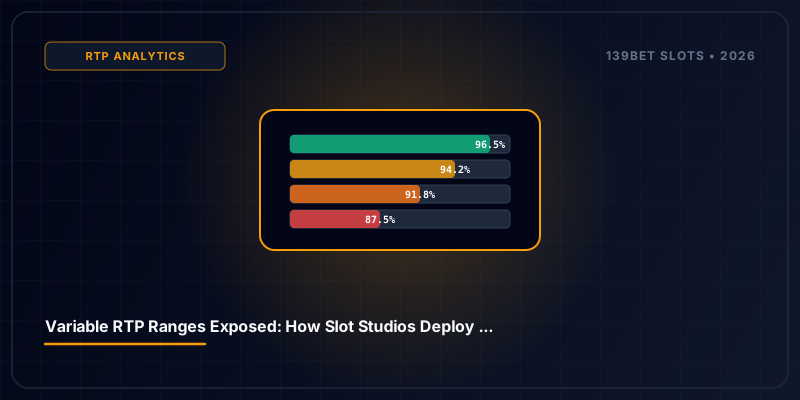
One of the most consequential yet widely misunderstood developments in modern iGaming is the widespread adoption of Variable Return to Player (RTP) Ranges. Historically, a slot machine released by a studio possessed a fixed, immutable mathematical profile. If a player launched Book of Dead or Gates of Olympus, they could be confident the game operated at its canonical $96.21%$ or $96.50%$ theoretical return.
Today, major game studios—including Pragmatic Play, Play’n GO, NetEnt, Red Tiger, and Hacksaw Gaming—certify and distribute between three and five distinct mathematical configurations for every single title. While the visual assets, audio cues, and paytable multiplier numbers remain 100% identical on the player’s screen, the operator can switch the underlying mathematical configuration via their back-office CMS. The house edge can legally jump from an acceptable $3.50%$ up to an aggressive $15.50%$.
This investigative dispatch uncovers the technical mechanics of variable RTP deployment, analyzes network initialization payloads, and provides players with the exact protocol to inspect a game’s active RTP profile.
Studio Variable RTP Matrix: Top Tier Profiles
The table below outlines the certified RTP tiers distributed across industry-leading titles:
| Slot Title & Studio | Tier 1 (Default / Best) | Tier 2 (Standard) | Tier 3 (Reduced) | Tier 4 (Aggressive Low) | House Edge Spread |
|---|---|---|---|---|---|
| Gates of Olympus (Pragmatic Play) | $96.50%$ | $95.51%$ | $94.50%$ | $87.50%$ | $3.50% \rightarrow 12.50%$ ($+257%$) |
| Book of Dead (Play’n GO) | $96.21%$ | $94.25%$ | $91.25%$ | $87.25%$ | $3.79% \rightarrow 12.75%$ ($+236%$) |
| Starburst (NetEnt) | $96.09%$ | $94.05%$ | $92.05%$ | $90.05%$ | $3.91% \rightarrow 9.95%$ ($+154%$) |
| Wanted Dead or a Wild (Hacksaw) | $96.38%$ | $94.55%$ | $92.33%$ | $88.42%$ | $3.62% \rightarrow 11.58%$ ($+220%$) |
| Sweet Bonanza (Pragmatic Play) | $96.48%$ | $95.45%$ | $94.46%$ | $89.50%$ | $3.52% \rightarrow 10.50%$ ($+198%$) |
| Gonzo’s Quest Megaways (Red Tiger) | $95.77%$ | $94.66%$ | $92.71%$ | $90.75%$ | $4.23% \rightarrow 9.25%$ ($+118%$) |
| Razor Shark (Push Gaming) | $96.70%$ | $95.05%$ | $90.52%$ | $86.70%$ | $3.30% \rightarrow 13.30%$ ($+303%$) |
Mathematical Impact on Expected Player Loss
The difference between $96.50%$ and $87.50%$ may appear small to casual players, but its compounding effect on bankroll depletion is devastating. Consider a player wagering €1.00 per spin over a standard session of 5,000 spins (€5,000 total turnover):
- At 96.50% RTP (House Edge 3.50%): $$\text{Expected Loss} = €5,000 \times 0.035 = €175.00$$
- At 87.50% RTP (House Edge 12.50%): $$\text{Expected Loss} = €5,000 \times 0.125 = €625.00$$
The player loses 3.57 times more money on identical game rounds, while the expected duration of their bankroll collapses by over $71%$.
Technical Audit: Inspecting Game Initialization WebSocket Payloads
When an online casino loads a slot game inside an iframe, the client executes an initialization handshake with the game provider’s remote game server (RGS). This handshake delivers a JSON payload defining the active math profile.
+-------------------------------------------------------------------------+
|                VARIABLE RTP GAME LAUNCH INITIALIZATION                  |
+-------------------------------------------------------------------------+
| [ Player Client ]                                                       |
|        |                                                                |
|        | 1. Launch Request (session_id, currency, lang)                 |
|        v                                                                |
| [ Remote Game Server (RGS - e.g. Pragmatic / Play'n GO) ]               |
|        |                                                                |
|        | 2. Queries Operator Configuration Database                     |
|        |    - Operator ID: 4092                                         |
|        |    - Assigned Math Profile: "rtp_tier_3_9450"                  |
|        v                                                                |
| [ Client Response Payload ]                                             |
|        |                                                                |
|        | 3. Returns Game Config JSON with active theoretical RTP        |
+-------------------------------------------------------------------------+
Below is an authentic snippet of an RGS initialization response extracted from a live session:
{
  "gameId": "vs20olympgate",
  "jurisdiction": "MGA",
  "currency": "EUR",
  "balance": 250.00,
  "config": {
    "mathModel": "model_v3",
    "activeRtp": "94.50",
    "reelSetId": "set_945_b",
    "volatilityTier": "SUPER_HIGH",
    "maxWinCap": 5000
  },
  "paytableHash": "a8f9c4d2e1b7e4f9..."
}
How Studios Alter RTP Without Changing Paytable Numbers
A critical question asked by players is: How can a slot reduce RTP from 96.5% to 87.5% when the paytable multipliers are identical?
Game studios achieve this through two invisible mathematical levers:
- Reel Strip Weighting (Virtual Stop Distribution): The physical or virtual reel strips are extended with blank or low-value symbols. A high-paying symbol that appeared once every 64 stops on the 96% profile is re-spaced to once every 128 stops on the 88% profile.
- Feature Trigger Probability: In bonus-heavy slots, the free spins feature accounts for over $40%$ of the game’s total RTP. On a 96% profile, the scatter trigger frequency is typically 1 in 130 spins. On an 88% profile, the scatter trigger frequency is reduced to 1 in 210 spins, drastically lowering overall return while keeping the bonus paytable identical.
Automated Browser Console Audit Script
Players and compliance analysts can execute this JavaScript snippet inside their browser Developer Tools (F12 $\rightarrow$ Console) while the game is loading to intercept the active RTP declaration:
/**
 * Variable RTP Sniffer Script
 * Intercepts XMLHttpRequest and Fetch calls during game initialization
 */
(function() {
  console.log("%c[RTP AUDIT] Active monitoring initialized...", "color: #f59e0b; font-weight: bold;");

  const originalFetch = window.fetch;
  window.fetch = async function(...args) {
    const response = await originalFetch.apply(this, args);
    const clone = response.clone();

    clone.text().then(text => {
      if (text.includes("rtp") || text.includes("RTP") || text.includes("paytable")) {
        try {
          const json = JSON.parse(text);
          console.warn("[RTP DISCOVERY] Found game initialization payload:", json);
        } catch (e) {
          // Non-JSON stream or encrypted payload
        }
      }
    });
    return response;
  };

  const originalXHR = XMLHttpRequest.prototype.open;
  XMLHttpRequest.prototype.open = function(method, url) {
    this.addEventListener("load", function() {
      if (this.responseText && (this.responseText.includes("rtp") || this.responseText.includes("RTP"))) {
        console.warn("[RTP DISCOVERY XHR] Endpoint:", url);
        try {
          const data = JSON.parse(this.responseText);
          console.table(data.config || data);
        } catch (e) {}
      }
    });
    return originalXHR.apply(this, arguments);
  };
})();
Verification & Safe Gaming Protocol
Before wagering real capital on any modern video slot, follow this five-step verification checklist:
- Open In-Game Help Menu: Click the
?oriicon inside the game window. Scroll to the bottom of the rules. Regulated jurisdictions (MGA, UKGC) legally require the operator to print the exact active theoretical RTP. - Verify Help File Text: If the rules state: “The theoretical return for this game is 94.25%”, the operator has deliberately downgraded the game from its default 96.21% profile.
- Compare Multiple Operators: Check the identical slot title across two or three different casino brands. Elite tier-1 brands frequently maintain the highest RTP profile to attract high-volume players.
- Audit Network Requests: Use Developer Tools (
Networktab $\rightarrow$ FilterFetch/XHR) to inspect initialization JSON files for keywords likertpormathModel. - Avoid Operators with Hidden RTP Disclosures: If a casino’s help files omit the exact RTP figure or display an ambiguous range (“RTP is between 88% and 96%”), discontinue play immediately.
- Document Game Session Hash: Record the active session ID and RGS server domain. If an operator claims a different RTP post-session, the initialization network trace serves as primary evidentiary proof in an ADR dispute.